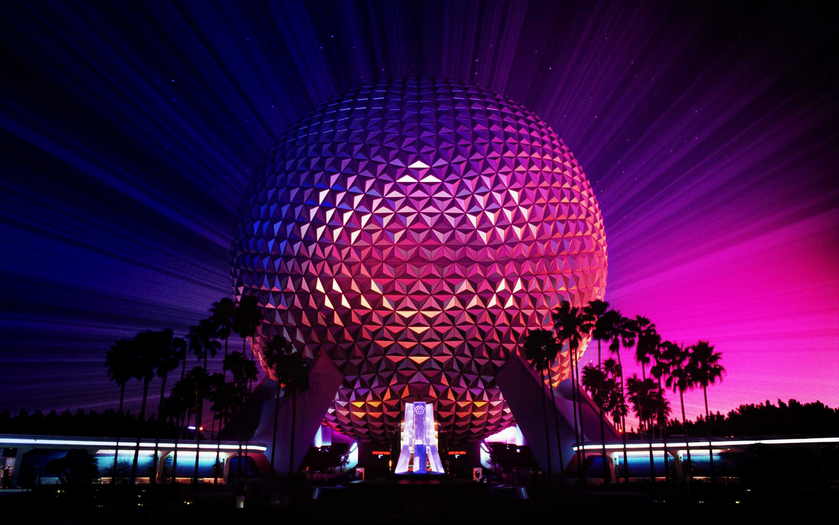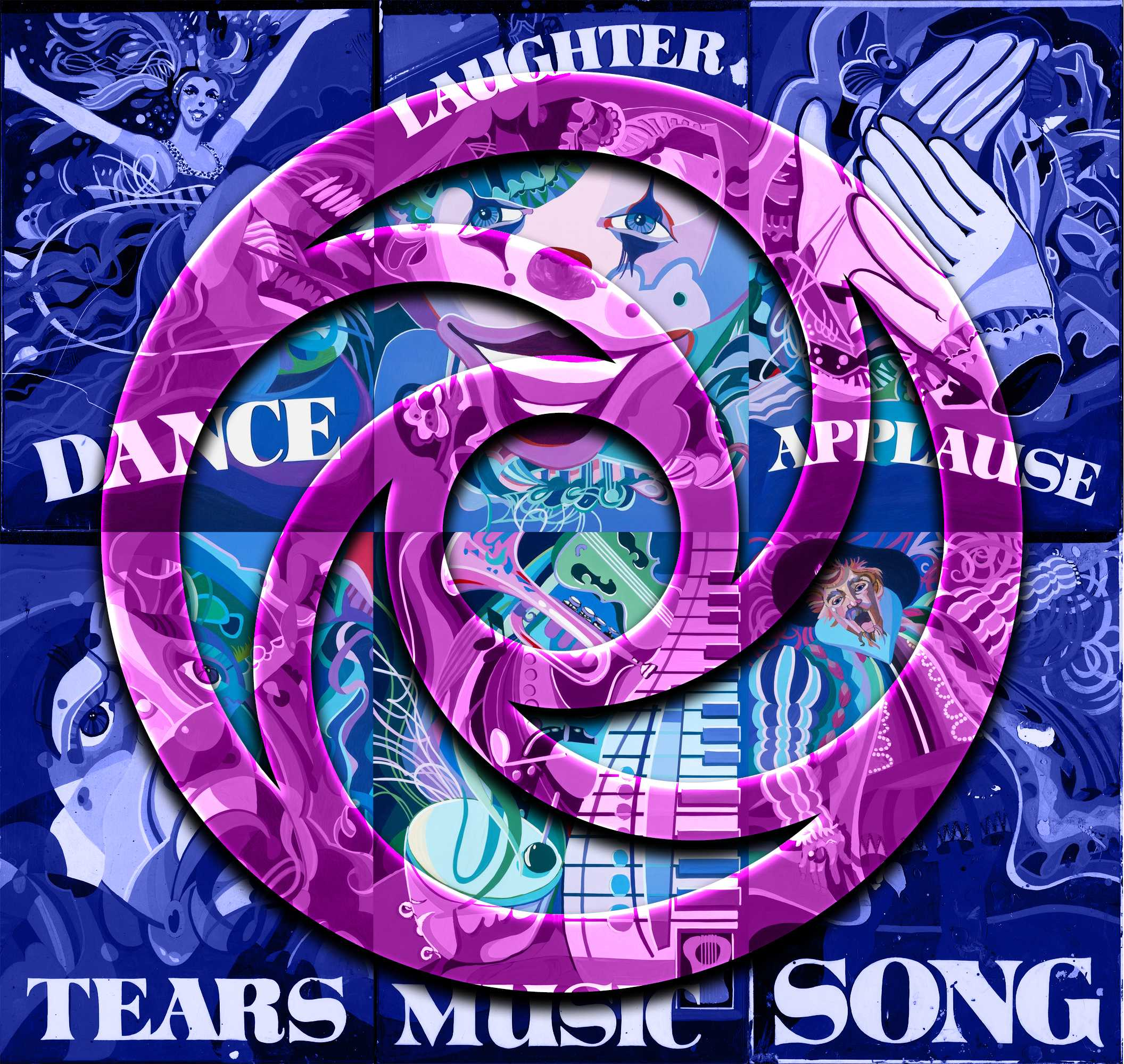
Whether it’s the eerie-eyed wallpaper in the Haunted Mansion, the tile murals of Cinderella Castle, or the fresco of an unmarred Hollywood Tower Hotel hiding in plain sight in its lower lobby, many attractions feature elements that are art installations in their own right. Epcot Center was no exception, featuring a plethora of masterpieces. Some of these, like Claudio Mazzoli’s Spaceship Earth entrance mural or Doris Hardoon’s wall carpet for The Land’s Harvest Theater, have, almost miraculously, survived, while most, such as Robert McCall’s “Prologue and the Promise” panorama for Horizons or Toshi Muto’s colorful ceiling for Journey into Imagination, have been gone for nearly a generation but not forgotten. Fortunately, the original reference paintings for the vast majority of these are still preserved at Walt Disney Imagineering’s Art Library. However, some of these were nearly lost forever in a nearly catastrophic incident few people know about…
In 2003, WDI’s Art Library experienced a fire. While the flames were extinguished quickly, many canvases suffered varying degrees of water damage from the building’s sprinkler system. Unfortunately, this included Journey into Imagination’s Performing Arts posters.
Painted by Julie Svendsen, these posters were seen as you entered the attraction’s sixth scene, “Performing Arts,” where, across the way, Actor Figment was getting ready for “A Brand New Show!”
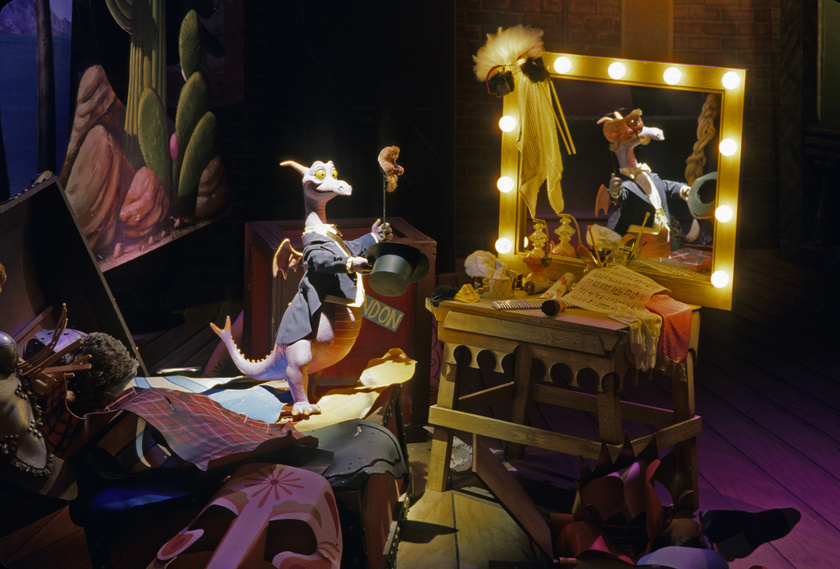
These six posters were mounted on three (then) newly developed “Prismavision” displays, each comprised of seven vertical triangular prisms that ingeniously rotated quickly from one image to the next. You can see them in action as part of Martin Smith's Ultimate Tribute (at 39:00) or more clearly on Disney Dave's 4K upscale (at 6:40).
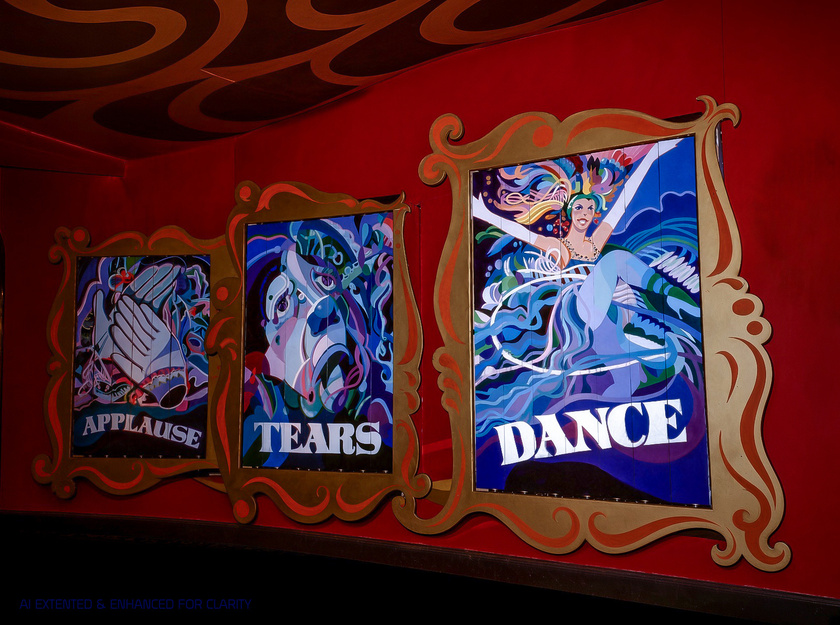
Meant to evoke theater posters under an abstract marquee and referencing the primary elements of any good performance, they also played off Dreamfinder and Figment’s alternating lyrics:
Some happy songs
Some snappy dances
Costumes and sets
Spoofs and romances
With laughs and tears
And footlights all aglow
The sparks ignite…
A brand new show!
As previously mentioned, Julie’s original paintings were badly damaged by the Art Library’s fire suppression system, but that didn’t stop curators Jeff Kurtti and Bruce Gordon from selecting them for inclusion in 2009’s The Art of Walt Disney World (pages 69 & 70).
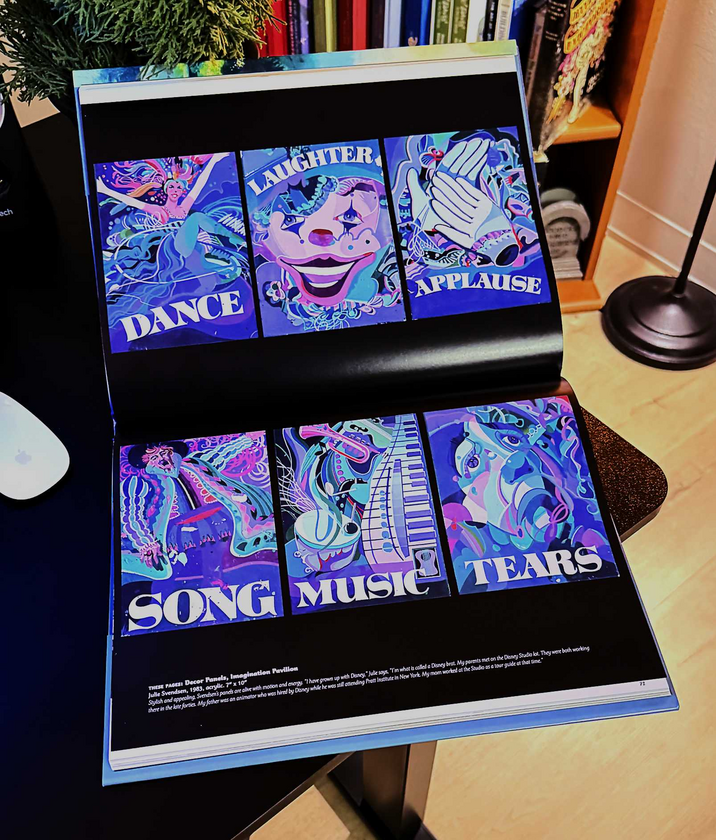
While it may be difficult to see at such a small scale in book form, once I acquired scans of the individual poster art, I was horrified by the amount of damage they had endured. From smudges to cracks, stains, chipped paint, and even large “varnish blooms” (permanent water droplets), if there was a type of damage a painting could suffer, they had it!
As with many other pieces of Future World production art, these have been on my (dauntingly long) list of assets to restore. But considering the extent of the damage and how niche the subject matter is—even most die-hard Imagination/Figment fans don’t remember these—they might never have seen the light of day if it were not for some recent technological advancements that did much (but most certainly not all) of the heavy lifting.
So now, for the first time in over 28 years, enjoy Julie Svendsen’s wonderfully whimsical kaleidoscopic compositions!
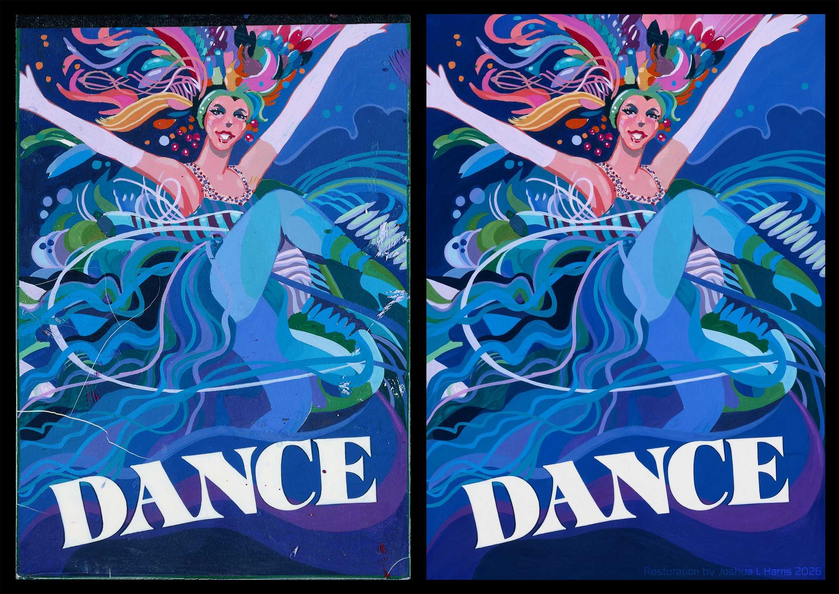
Each functions as a stylized theatrical poster rather than a literal illustration of its subject. Figures, instruments, faces, and gestures are reduced to bold, interlocking shapes that feel both graphic and fluid, closer to mid-century poster art and kaleidoscopic abstraction than straightforward representation.
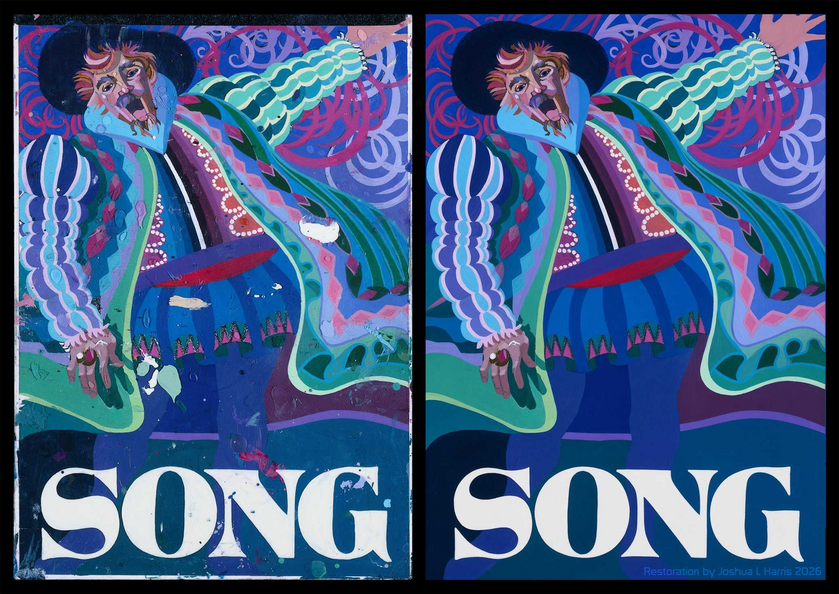 The "SONG" poster suffered the most damage, but was fortunately pulled back from the brink.
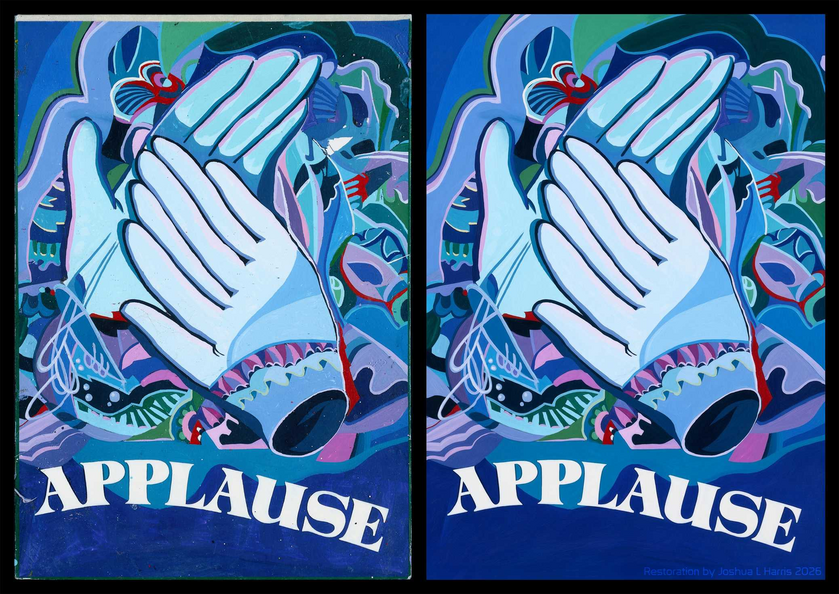
A cool, high-saturation palette dominates across the set (deep and mid-tone blues, teals, purples, and magentas, with sharper pink, green, and occasional red accents). The white title lettering is consistently large, clean, and high-contrast, anchoring each composition and reinforcing the “theater poster under an abstract marquee” concept. 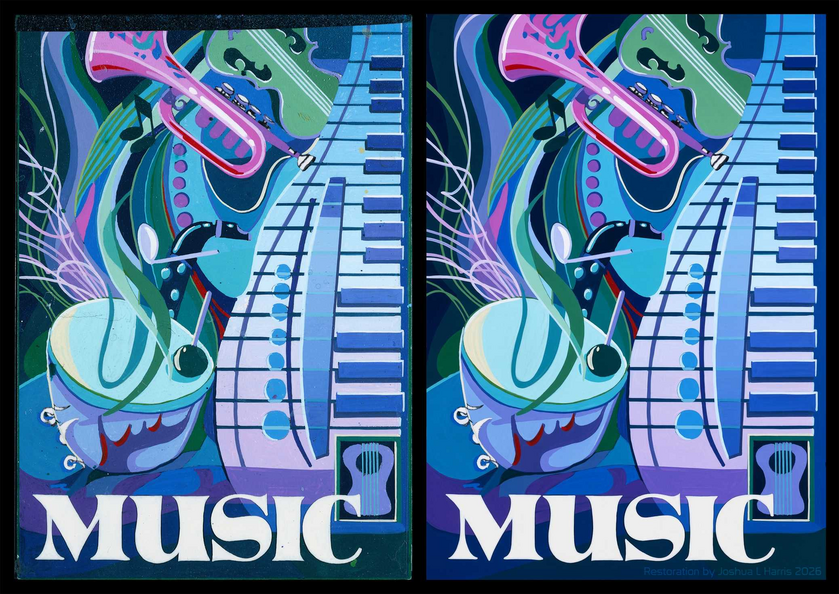
The backgrounds are rarely empty; instead, they swirl and fragment around the central motifs, creating a sense of energy and movement appropriate to live performance.
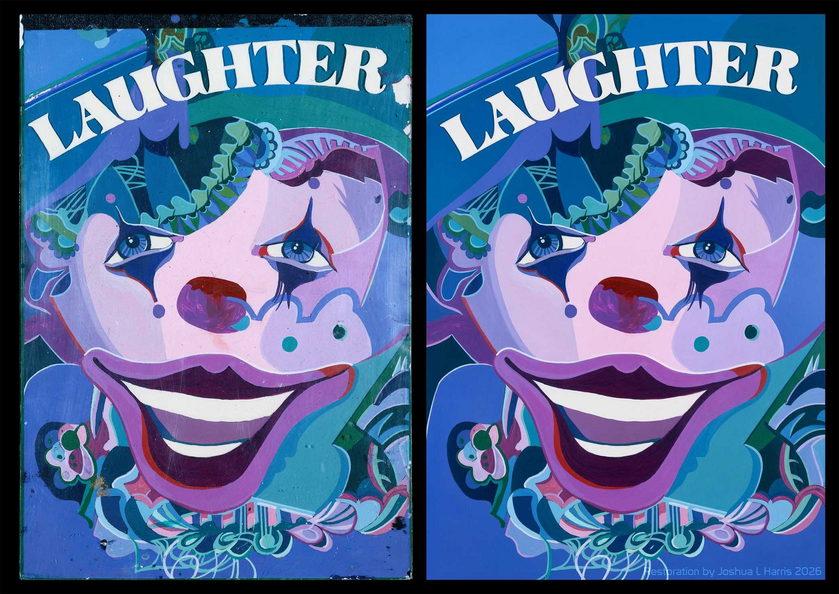
Collectively, the posters succeed because they are immediately legible as a set while remaining richly detailed. They feel playful and theatrical without becoming cartoonish, and their consistent visual language - bold contours, flat-to-modeled color, and a shared cool palette makes them work both as individual images and as a rotating display.
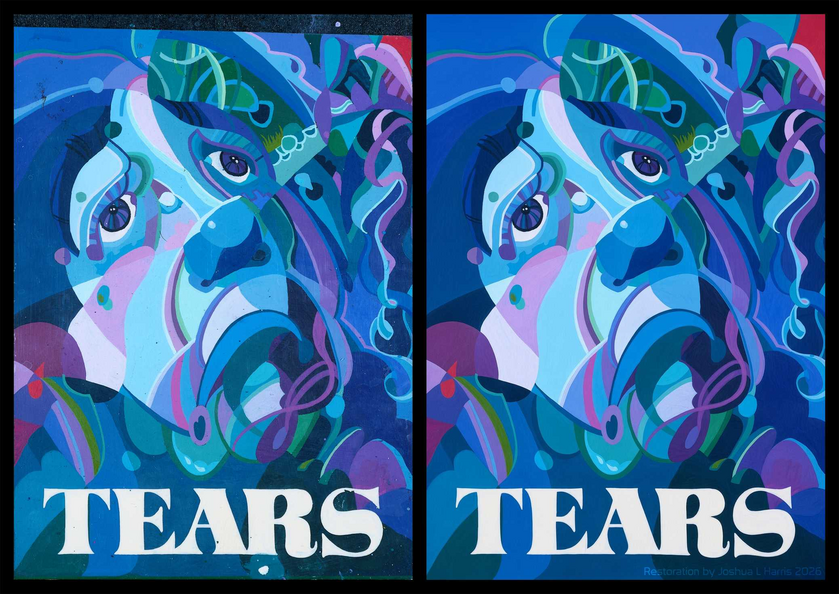
The abstraction also helps them function as stage scenery: they evoke the spirit of performance rather than depicting specific shows, allowing them to support Dreamfinder and Figment’s lyrics without competing with the action across the way.